Prioritization of AI in strengthening the competitiveness of the Czech Republic
17 \ 04 \ 2025
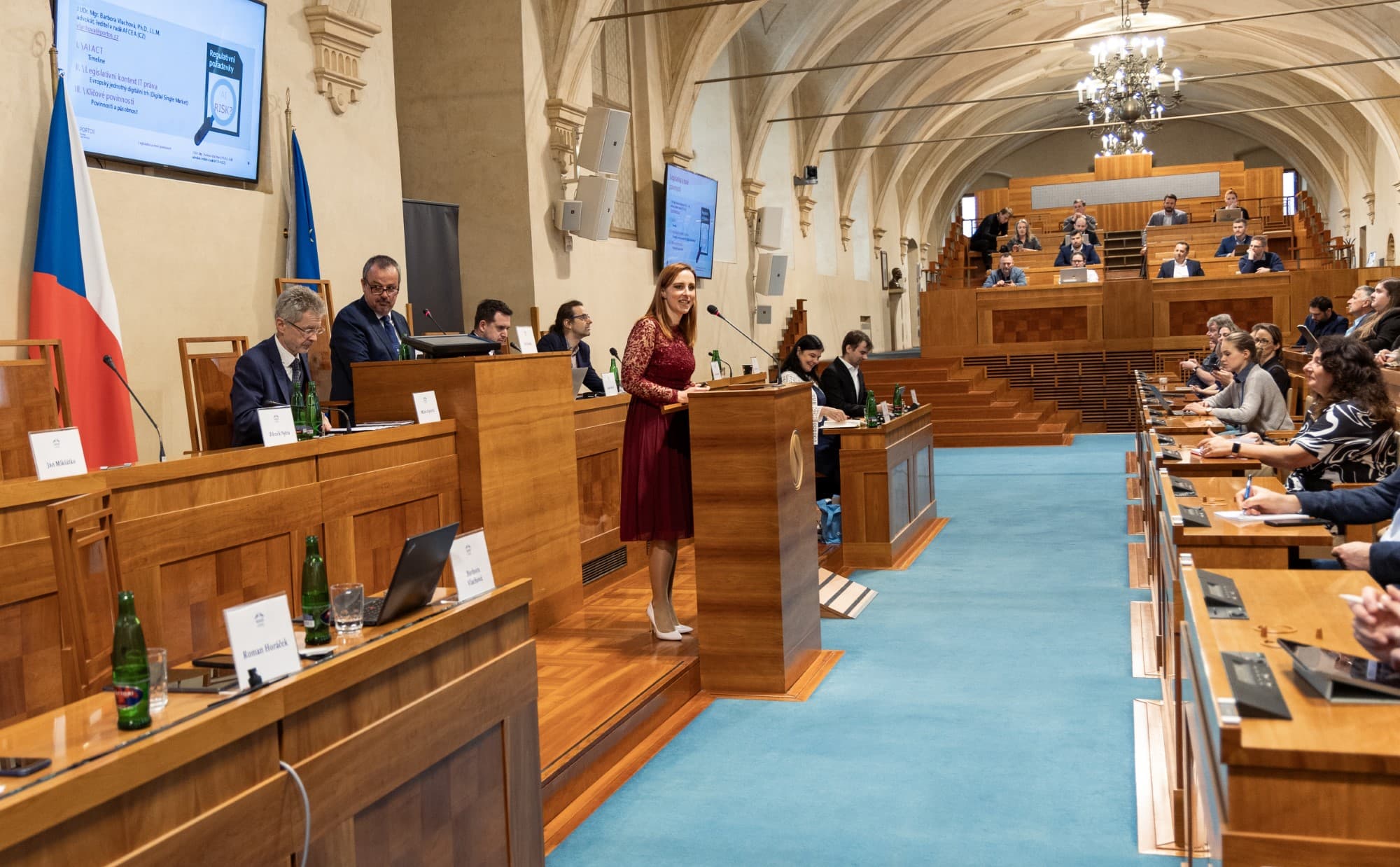
The Czech Association of Artificial Intelligence, with the support of Senate President Miloš Vystrčil, organised an expert conference Prioritisation of AI in Strengthening the Competitiveness of the Czech Republic. The subject was a discussion on strategic priorities for AI development, key challenges and opportunities for Czech industry, public administration and academia.
The meeting brought together sector experts who are jointly looking for ways to use AI for the economic and technological development of the Czech Republic.
“Euphoric deployment of AI tools in all spheres of social activity only for fear of missing the marketing train or the desire to demonstrate superficial innovation is not a responsible approach” - believes Martin Vlasta, Director of the Advocacy Association for AI. “Experience from practice clearly shows that sometimes a thorough digitalisation is sufficient, which can significantly mitigate the risks associated with AI”.
The Bar Association for AI underlines the values expressed in the Czech Bar Association's opinion of 15 September 2023 on the use of AI in advocacy. AI tools always work with statistics and with a certain degree of uncertainty, and therefore, in the context of justice and advocacy, very careful consideration must be given to how to distinguish between actions requiring full human expertise and sub-steps that can be delegated to AI. Particularly for critical processes where the human factor must remain an indispensable component. "We mustn't get into a situation where we leave decisions to machines who, when they decide - No. And a human when asked why? He will not get a reasoned explanation or a way to reach a remedy." concludes Martin Vlasta. It is therefore essential to have both legal and human oversight of AI outputs, especially for decision-making processes where the human factor is to remain an indispensable component. This requirement can be called the right to a human judge, or the right to human review.
A key point is the respect for attorney-client privilege, i.e. data confidentiality, which should be at the forefront of a responsible approach to deploying AI technologies. Attorneys must always protect sensitive information and work with models in ways that do not undermine credibility in the administration of justice or compromise clients' rights.
Digital sovereignty over key systems and data is the only proper European way to ensure the independence and impartiality of our judicial professions.
"Law goes hand in hand with morality. If morality limps, law will soon start to limp. That is why we are seeing today efforts to devalue any principles and moral principles, including those that are absolutely fundamental, such as the right and duty to defend one's state and its citizens. The prevailing view is that everything is somehow ‘relative’, including the law and its application. However, we must not succumb to these perceptions, even when it comes to the application of artificial intelligence." explains JUDr. Roman Horáček, Ph.D., Vice-Chairman of the High Court in Prague for the Civil Section and founder of the Centre for Digitalization and Artificial Intelligence in Justice (CENDAI).
Society today finds it difficult to cope with the pressure of waves of misinformation. Judicial practice today can, albeit with extreme difficulty, detect fraudulent acts in the taking of evidence. It is common to examine the authenticity of a signature, the age of a document. However, in the era of AI, there are sure to be wrinkles on the forehead. Evidence fraud will become more technically and organisationally sophisticated, and only AI will be able to detect it. Therefore, there is already a need for procedural regulations that will lead litigants to be cautious when presenting such “doctored” evidence to the court.
There are already provisions in many states' procedural rules that make it mandatory for litigants to disclose that the evidence has been “influenced” by an AI model. If they fail to do so, the evidence is deemed to be against them. It's just a raised finger, but it's certainly enough to start with, explains Roman Horáček.
It is important to remember that not every intervention of artificial intelligence in the evidence is negative. Today, there are AI tools that can enhance a blurry image so that it is legible, they can fill in part of the audio recording, etc. All of these tools can be used to seek justice, not just to obfuscate the truth.
Conference programme
9:00 to 9:15
Opening address by the President of the Senate of the Czech Republic, M. Vystrčil
Moderator: Jiří Dušek - Senator
9:15 to 10:00
AI Here and Now.
Artificial Intelligence is no longer a question of the future - its development affects the economy, security, democracy and legislation in real time. The opening session will provide the most up-to-date information on AI, debunk common myths and help put the issue in a political context where Europe, including the Czech Republic, is finding its place between the US and China.
Lukáš Benzl - Director of the Czech Association of Artificial Intelligence
Přemysl Rosůlek - political scientist Faculty of Philosophy, University of Technology in Pilsen
Jan Kavalírek - Deputy Minister of the MIT of the Czech Republic
10:00 to 11:00
AI and Our Competitiveness.
Artificial intelligence can be the engine of growth for the Czech Republic - if we can use its potential correctly. This session will focus on specific areas where AI can strengthen our competitiveness, from healthcare to public administration to promoting digital literacy. Where are we most likely to succeed?
Healthcare.
Public administration: Petr Kohout - Regional Authority of the Central Bohemian Region and Platform for AI in Public Administration
Digital literacy.
AI and European competitiveness: Tomáš Dvořák - senior consultant Nemec+Chvatal
11:30 to 12:15
Czech AI science and industry
The Czech Republic has a strong academic base in the field of artificial intelligence. We will present key departments, projects, but also the needs of the AI scientific community. We will also look at the AI startup scene, its position in the world and where there is room for improvement.
Lukáš Kačena - director of prg.ai
Josef Šivic - CTU
Jan Mikšátko - Executive Director of ententee
12:15 to 13:00
AI in Czech legislation and justice
The European Regulation on Artificial Intelligence (AI Act) will fundamentally influence how AI will be developed and used in the Czech Republic. This session will focus on its implementation in the Czech legal framework, key obligations for companies and institutions, and the protection of citizens' rights. We will also look at AI in the judiciary, including the legal limits and the impact on the administrative burden of the courts.
Mgr. Martin Vlasta - Director of the Lawyers' Association for AI
JUDr. Roman Horáček, Ph.D - High Court in Prague and Centre for Digitalization and AI in Justice
JUDr. Mgr. Barbora Vlachová, Ph.D., LL.M. - Advocate PORTOS, Director on the Board of AFCEA (CZ)

JUDr. Mgr. Barbora Vlachová, Ph.D., LL.M.
Team Leader